
Journeys
The expeditions, reassembled
Every dated label is a diary entry. Read a collector’s labels in order and the voyage comes back: the islands in sequence, the days at each, the specimens from every stop. 20 journeys so far, 1910 to 1919, 9,451 specimens between them.
7 collectors and expeditions451 days in the field18,665 km between stops7,472 photographed specimens
20 journeys match

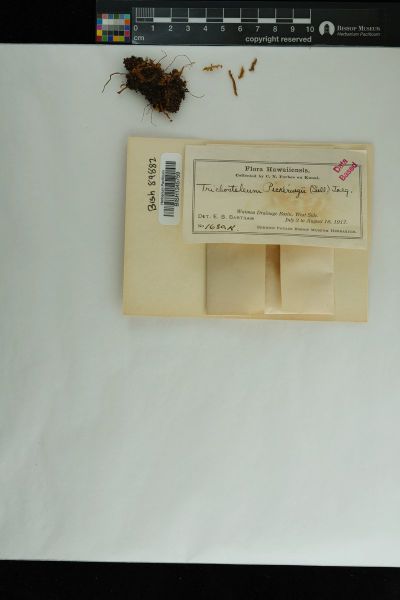

Charles N. Forbes
5 islands of the United States · Jun – Dec 1917
Charles N. Forbes across 5 islands of the United States, June – December 19171,777 specimens · 29 stops · 163 days · 2,815 km


Joseph F. Rock
6 islands of the United States · Jun – Nov 1910
Joseph F. Rock across 6 islands of the United States, June – November 19101,111 specimens · 45 stops · 154 days · 2,685 km


Charles N. Forbes
6 islands of the United States · May – Jul 1915
Charles N. Forbes across 6 islands of the United States, May – July 19151,032 specimens · 49 stops · 79 days · 992 km


Charles N. Forbes
6 islands of the United States · Jun – Sep 1919
Charles N. Forbes across 6 islands of the United States, June – September 19191,048 specimens · 28 stops · 88 days · 422 km


Charles N. Forbes
5 islands of the United States · Sep – Dec 1916
Charles N. Forbes across 5 islands of the United States, September – December 1916451 specimens · 23 stops · 106 days · 1,301 km
Charles N. Forbes
5 islands of the United States · Jan – Jun 1912
Charles N. Forbes across 5 islands of the United States, January – June 1912459 specimens · 19 stops · 151 days · 981 km
John August Kusche
Kauaʻi and Hawaiʻi Island · Jan – Jun 1919
John August Kusche in Kauaʻi and Hawaiʻi Island, January – June 1919682 specimens · 35 stops · 142 days · 450 km


Charles N. Forbes
4 islands of the United States · Jun – Aug 1912
Charles N. Forbes across 4 islands of the United States, June – August 1912567 specimens · 12 stops · 44 days · 287 km


 A.S. Hitchcock
6 islands of the United States · Jun – Oct 1916
A.S. Hitchcock across 6 islands of the United States, June – October 1916239 specimens · 51 stops · 142 days · 1,990 km


Joseph F. Rock
5 islands of the United States · Mar – May 1910
Joseph F. Rock across 5 islands of the United States, March – May 1910361 specimens · 11 stops · 68 days · 120 km


Charles N. Forbes
4 islands of the United States · Jun – Jul 1913
Charles N. Forbes across 4 islands of the United States, June – July 1913406 specimens · 8 stops · 38 days · 774 km
Clarence H. Cooke Jr.
Kauaʻi and Molokaʻi · Jun – Jul 1914
Clarence H. Cooke Jr. in Kauaʻi and Molokaʻi, June – July 1914303 specimens · 7 stops · 37 days · 413 km


Charles N. Forbes
5 islands of the United States · Jun – Sep 1910
Charles N. Forbes across 5 islands of the United States, June – September 1910246 specimens · 9 stops · 65 days · 763 km


Joseph F. Rock
5 islands of the United States · Aug – Nov 1916
Joseph F. Rock across 5 islands of the United States, August – November 1916205 specimens · 13 stops · 77 days · 1,762 km


Joseph F. Rock
Kauaʻi and Oʻahu · 1–24 Oct 1911
Joseph F. Rock in Kauaʻi and Oʻahu, 1–24 October 1911148 specimens · 5 stops · 24 days
Clarence H. Cooke Jr.
Molokaʻi and Kauaʻi · Mar – Apr 1914
Clarence H. Cooke Jr. in Molokaʻi and Kauaʻi, March – April 1914105 specimens · 4 stops · 25 days · 343 km
Carolene Charley
Kauaʻi · 14–19 Jun 1914
Carolene Charley in Kauaʻi, 14–19 June 1914140 specimens · 3 stops · 6 days · 64 km


Charles N. Forbes
3 islands of the United States · Oct 1910 – Jan 1911
Charles N. Forbes in Oʻahu, Maui and Kauaʻi, October 1910 – January 191148 specimens · 16 stops · 97 days · 1,320 km


Joseph F. Rock
3 islands of the United States · Aug – Oct 1917
Joseph F. Rock in Hawaiʻi Island, Oʻahu and Kauaʻi, August – October 191740 specimens · 10 stops · 39 days · 1,127 km
C.M.Cooke III
Kauaʻi · 14–19 Jun 1914
C.M.Cooke III in Kauaʻi, 14–19 June 191483 specimens · 3 stops · 6 days · 56 km
How a journey is found
Every specimen with a full date and a known collector is a diary entry. The days are read in order; a gap of more than three weeks ends one journey and starts the next. Days spent where a collector lived most of their life are home, not travel, and are left out.
A journey needs at least five days, forty specimens and two places. Within it, a run of days spent within about ten kilometres is one stop; the stop’s point is the middle of the labels that carry coordinates, or the island’s centre when none do.
Companions are the people whose own labels put them in the same place on the same days. Staff can name a journey, write about it and feature it; everything else here is read straight off the specimens, and is rebuilt as the records improve.