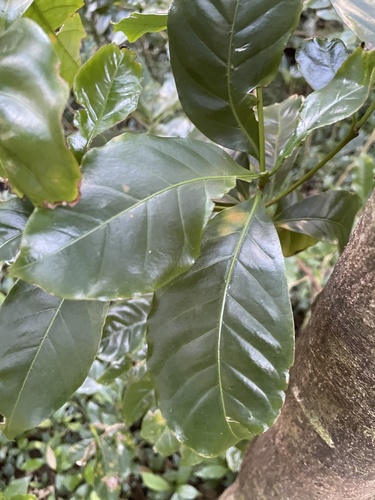
Coffea liberica
Excelsa Coffee
Photo: (c) Liselle Santos, some rights reserved (CC BY-NC), uploaded by Liselle Santos (iNaturalist)
41
Bishop specimens
0
Type specimens
1910
First collected
2025
Last collected
2024
Last seen alive in Hawaiʻi
In the Library
Bishop Museum publications whose pages name Coffea liberica, most mentions first.
2019
Hawaiian naturalized vascular plants checklist (February 2019 update)Imada, C. · Contribution to the Hawaii Biological Survey · 2 pages
2025
Imada, C.T., Faccenda, K., Thomas, M.K., Gallaher, T., Oppenhemier, H., Kennedy, B. & Kalei, A. (eds.) Hawaiian native & naturalized vascular plants checklist (2025 update). 780 pp. [published online 6 November 2025]· Contribution to the Hawaii Biological Survey · 1 page
2013
Records of the Hawaii Biological Survey for 1994–2013: IndexEvenhuis, N.L. & Eldredge, L.G. (eds) · Records of the Hawaii Biological Survey · 1 page
2002
Index to the Records of the Hawaii Biological Survey for the years 1994 through 2000Evenhuis, N.L. · Contribution to the Hawaii Biological Survey · 1 page
2000
New Hawaiian plant records for 2000Staples G.W., C.T. Imada & D.R. Herbst · Contribution to the Hawaii Biological Survey · 1 page
2000
Survey of invasive or potentially invasive cultivated plants in Hawai‘iStaples, G.W., D. Herbst & C.T. Imada · Contribution to the Hawaii Biological Survey · 1 page
2000
Records of the Hawaii Biological Survey for 1994–2000: IndexEvenhuis, N.L. & Eldredge, L.G. (eds) · Records of the Hawaii Biological Survey · 1 page
Where Bishop collected it
8 mapped specimens. Localities of endangered species are shown approximately.
Two centuries of collecting
The oldest Bishop specimen was collected in 1910 by Tilden, J.E. (Tahiti).
From the collection


Alive today
1 research-grade iNaturalist sightings in the wild in Hawaiʻi since 2000. Most recent first.