
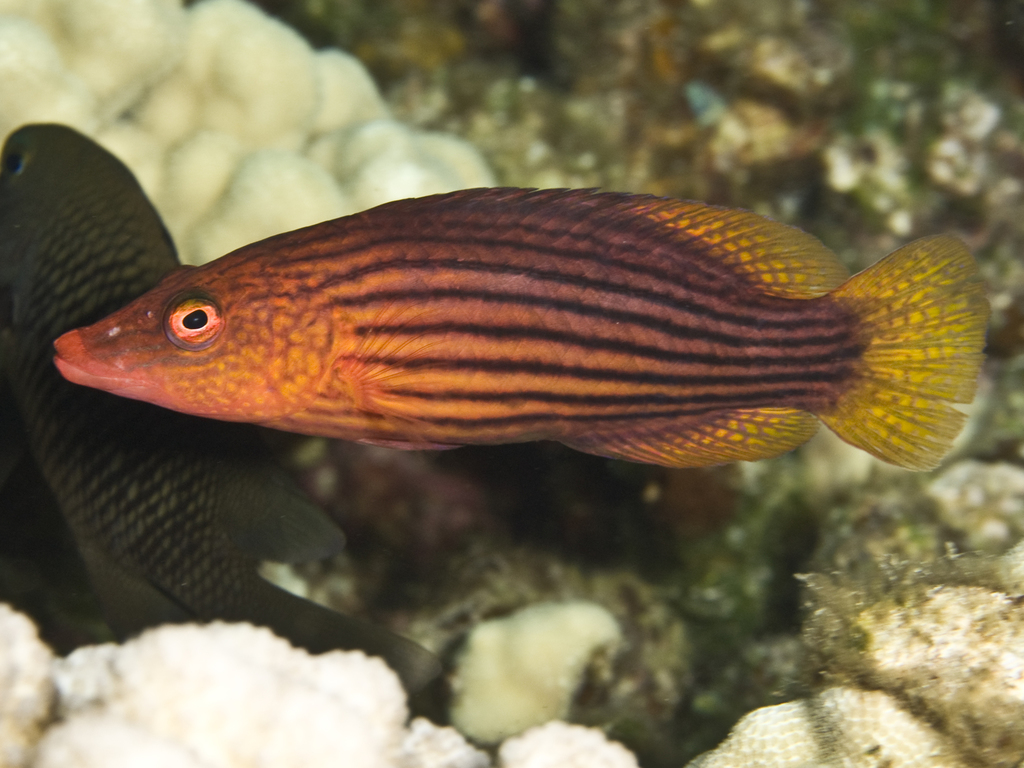
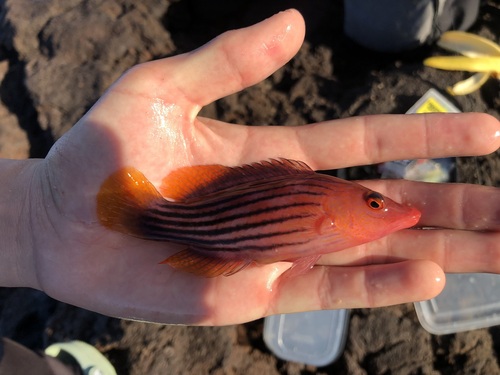
Pseudocheilinus octotaenia
Eight-line Wrasse
Jenkins, 1901Accepted name in the World Register of Marine Species.WoRMS 208914 ↗
Photo: (c) Philip Thomas, some rights reserved (CC BY-NC), uploaded by Philip Thomas (iNaturalist)
50
Bishop specimens
0
Type specimens
1901
First collected
1997
Last collected
2026
Last seen alive in Hawaiʻi
In the Library
Bishop Museum publications whose pages name Pseudocheilinus octotaenia, most mentions first.
2008
Assessment of species composition, diversity and biomass in marine habitats and subhaqbitats around offshore islets in the main Hawaiian IslandsColes, S.L., Giuseffi, L. & Hutchinson, M. · Contribution to the Hawaii Biological Survey · 4 pages
2010
Marine biota information base for offshore islets in the main Hawaiian IslandsColes, S.L. & Swenson, C. · Contribution to the Hawaii Biological Survey · 3 pages
2004
Assessment of nonindigenous species on coral reefs in the Hawaiian Islands, with emphasis on introduced invertebratesColes, S.L., L.G. Eldredge, F. Kandel, P.R. Reath & K. Longenecker · Contribution to the Hawaii Biological Survey · 2 pages
2002
Nonindigenous marine species at Waikiki and Hawaii Kai, O‘ahu, Hawai‘iColes, S.L., R.C. DeFelice & L.G. Eldredge · Contribution to the Hawaii Biological Survey · 2 pages
2001
Marine species survey of Johnston Atoll, central Pacific Ocean, June 2000Coles, S.L., R.C. DeFelice & D. Minton · Contribution to the Hawaii Biological Survey · 2 pages
2023
Monitoring the diurnal and seasonal foraging of Hawaiian monk seals in mesophotic rubble habitat using seafloor event loggers called “electric rocks”Parrish, F.A., R.C. Boland, M. Sawyer, B. Greene, B. Buhleier, and G.M. Marshall · Museum research publication · 1 page
2002
Nonindigenous marine species in Kane‘ohe Bay, O‘ahu, Hawai‘iColes, S.L., R.C. DeFelice & L.G. Eldredge · Contribution to the Hawaii Biological Survey · 1 page
Where Bishop collected it
2 mapped specimens. Localities of endangered species are shown approximately.
Two centuries of collecting
The oldest Bishop specimen was collected in 1901 by J.W. Thompson (Oʻahu). The Museum last collected it in 1997; iNaturalist observers have seen it in the wild as recently as September 14, 2026.
Alive today
118 research-grade iNaturalist sightings in the wild in Hawaiʻi since 2000. Most recent first.
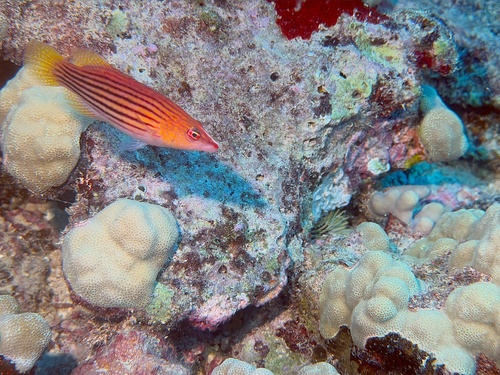
2026-09-14
Mamala Bay, HI, US
(c) Rad Dad Chad, some rights reserved (CC BY-NC)
2026-08-02
Kāʻanapali, HI, US
(c) PiperB, some rights reserved (CC BY-NC)
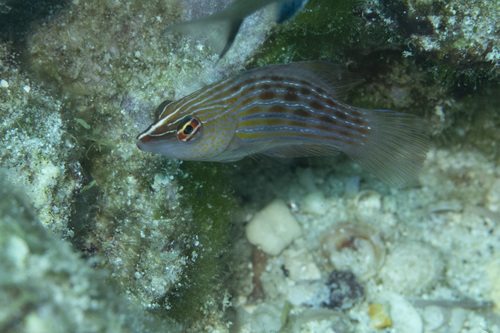
2026-07-13
Kalaoa, HI 96740, USA
(c) cello caruso-turiello, some rights reserved (CC BY)
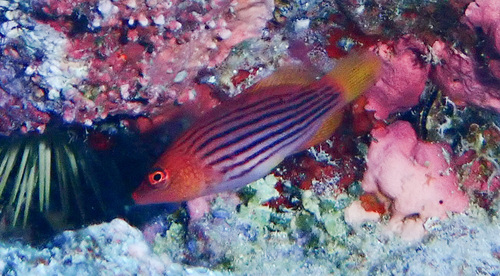
2026-04-25
Kalaoa, HI 96740, USA
(c) deefulton, some rights reserved (CC BY-NC)
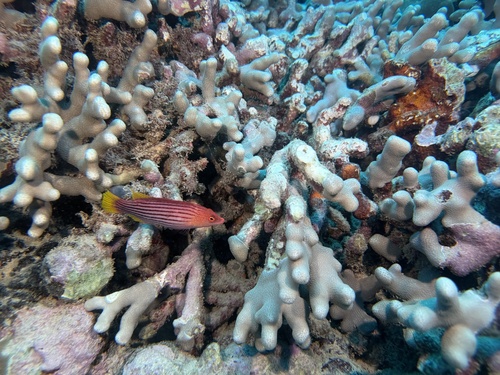
2026-04-19
Mamala Bay, HI, US
(c) Rad Dad Chad, some rights reserved (CC BY-NC)
2026-03-06
Poipu, HI 96756, USA
(c) Ryan Shaw, some rights reserved (CC BY-NC)
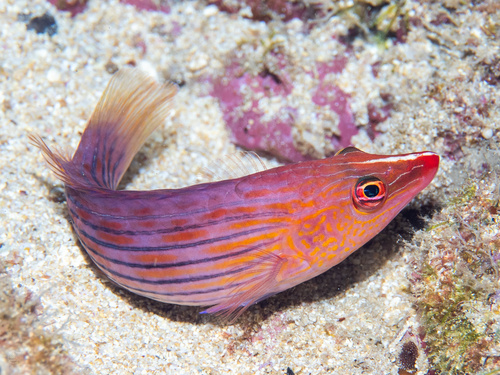
2026-02-21
Honolulu County, US-HI, US
(c) Olie Turner III, some rights reserved (CC BY-NC)
2026-02-18
Kaanapali, HI, USA
(c) Kai, some rights reserved (CC BY-NC)