
Journeys
The expeditions, reassembled
Every dated label is a diary entry. Read a collector’s labels in order and the voyage comes back: the islands in sequence, the days at each, the specimens from every stop. 1,039 journeys so far, 1879 to 2026, 190,135 specimens between them.
396 collectors and expeditions17,317 days in the field3,803,657 km between stops132,409 photographed specimens
1,039 journeys match


C.H. Lamoureux
3 islands · 12–17 Aug 1964
C.H. Lamoureux in Kure Atoll, Midway Atoll and Laysan, 12–17 August 196445 specimens · 4 stops · 6 days · 111 km


C. Squair
Hawaiʻi Island and Oʻahu · Nov – Dec 2005
C. Squair in Hawaiʻi Island and Oʻahu, November – December 200557 specimens · 2 stops · 11 days · 31 km


Timothy Flynn
Hawaiʻi Island and Maui · 24–28 Jul 1983
Timothy Flynn in Hawaiʻi Island and Maui, 24–28 July 198344 specimens · 4 stops · 5 days


D. Brokaw
Maui · 11–15 Mar 2024
D. Brokaw in Maui, 11–15 March 202443 specimens · 4 stops · 5 days


J. Garnic
the United States · 12–18 Aug 1947
J. Garnic in the United States, 12–18 August 194764 specimens · 2 stops · 7 days
J.D. Rogers
4 islands of the United States · 4–16 Jan 1996
J.D. Rogers across 4 islands of the United States, 4–16 January 199648 specimens · 11 stops · 13 days · 788 km


B. Jones
Oʻahu and Hawaiʻi Island · May – Jun 1988
B. Jones in Oʻahu and Hawaiʻi Island, May – June 1988106 specimens · 2 stops · 10 days · 299 km


Charles N. Forbes
Oʻahu · Aug – Sep 1915
Charles N. Forbes in Oʻahu, August – September 191566 specimens · 2 stops · 16 days
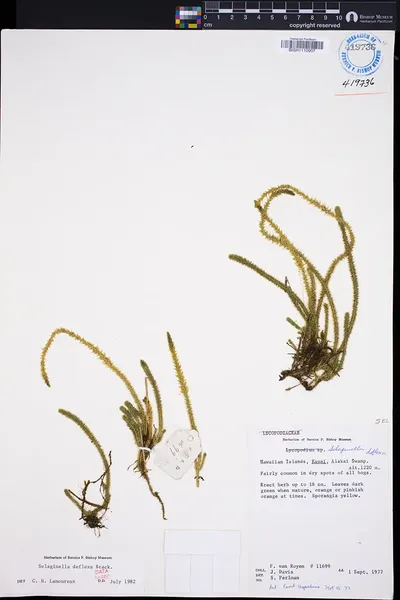


J.S. Davis
Kauaʻi · Aug – Sep 1977
J.S. Davis in Kauaʻi, August – September 197742 specimens · 4 stops · 5 days


G.J. Hollenberg
5 islands of the United States · Apr – May 1965
G.J. Hollenberg across 5 islands of the United States, April – May 196551 specimens · 5 stops · 16 days · 192 km


 C.M. Iltis
Hawaiʻi Island · 19–23 Jun 1967
C.M. Iltis in Hawaiʻi Island, 19–23 June 196743 specimens · 4 stops · 5 days · 8 km


A.D. Tribollet
Lānaʻi and Niʻihau · 4–12 Aug 2006
A.D. Tribollet in Lānaʻi and Niʻihau, 4–12 August 200640 specimens · 4 stops · 9 days · 372 km


E.S.C. Handy
Maui and Molokaʻi · 4–18 Jun 1931
E.S.C. Handy in Maui and Molokaʻi, 4–18 June 193150 specimens · 2 stops · 15 days · 108 km

Brenda Bishop
3 islands of the United States · 3–18 Aug 1963
Brenda Bishop in Molokaʻi, Oʻahu and Kauaʻi, 3–18 August 196349 specimens · 2 stops · 16 days · 50 km


R.B. Sylva
Maui · 3–12 Jul 1978
R.B. Sylva in Maui, 3–12 July 197841 specimens · 3 stops · 10 days · 64 km


 W.H. Magruder
Hawaiʻi Island · 18–28 May 1988
W.H. Magruder in Hawaiʻi Island, 18–28 May 198876 specimens · 3 stops · 11 days · 128 km


Timothy Flynn
3 islands · Oct – Nov 1989
Timothy Flynn in Upolu, Savaii and Maui, October – November 198943 specimens · 7 stops · 13 days · 4,300 km


Robert B. Moffitt
Maro Reef · Jun – Jul 2000
Robert B. Moffitt in Maro Reef, June – July 200040 specimens · 4 stops · 6 days · 89 km


Edwin Horace Bryan Jr.
Hawaiʻi Island · 23–28 Nov 1932
Edwin Horace Bryan Jr. in Hawaiʻi Island, 23–28 November 193245 specimens · 6 stops · 6 days


E.F. Bishop
Kodiak and Kodiak Island · 3–14 Jun 1973
E.F. Bishop in Kodiak and Kodiak Island, 3–14 June 197349 specimens · 2 stops · 12 days


J.S. Davis
Kauaʻi · 2–9 Sep 1979
J.S. Davis in Kauaʻi, 2–9 September 197944 specimens · 3 stops · 8 days


M. LeGrande
3 islands of the United States · Feb – Mar 2003
M. LeGrande in Niʻihau, Lānaʻi and Kahoʻolawe, February – March 200349 specimens · 3 stops · 32 days · 441 km


R. Won
Oʻahu · 5–10 May 1954
R. Won in Oʻahu, 5–10 May 195452 specimens · 2 stops · 6 days


D. Orr
Oʻahu · 16–23 Dec 1994
D. Orr in Oʻahu, 16–23 December 199452 specimens · 2 stops · 8 days
How a journey is found
Every specimen with a full date (year, month and day; a bare “1 January” is treated as a missing day) and a named collector is a diary entry. For each collector the days are read in order, each day given the place most of its labels name. The place where a collector spent more than forty percent of their days, and at least sixty of them, is home: days there are left out.
A gap of more than 21 days between collecting days ends one journey and begins the next. A journey must run five to four hundred days, hold at least forty specimens and touch at least two places. Within it, consecutive days inside the same or a neighbouring tenth-of-a-degree cell (about eleven kilometres) are one stop; the stop’s point is the mean of its labels’ coordinates, or the island’s centre when none carry any.
Companions are collectors whose own labels put them in the same cell on the same days. Staff can name a journey, write about it, feature it or hide it; those words survive every rebuild. Everything else is read off the specimens and rebuilt by harvest.mjs expeditions as the records improve.